One Year In: What Study Permit Caps Are Really Doing to B.C.'s Economic Future
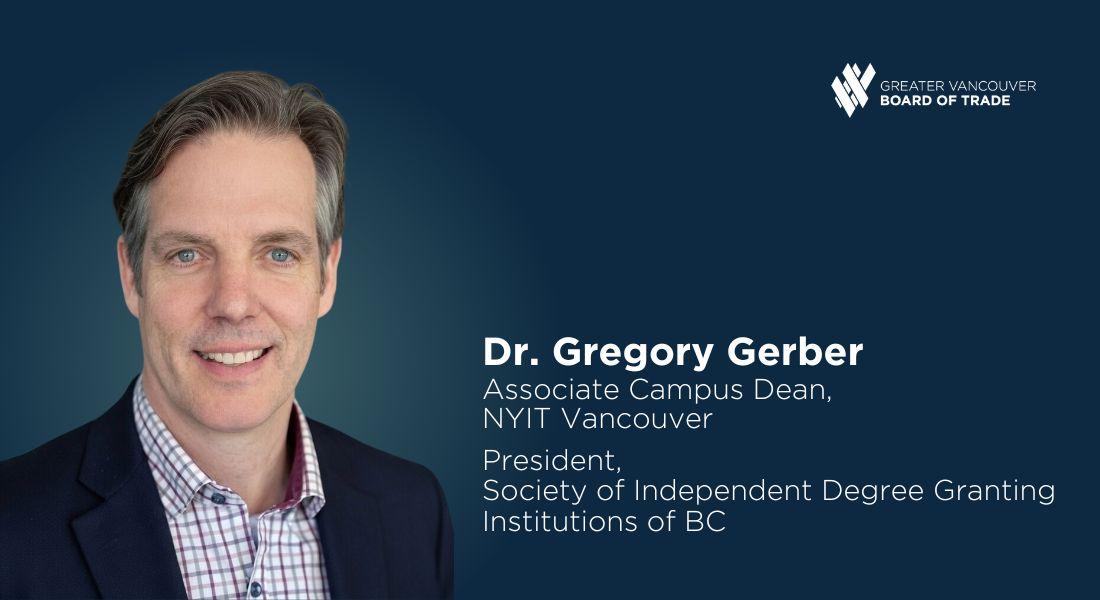
Op-ed by Dr. Gregory Gerber
Associate Campus Dean at NYIT Vancouver & President, Society of Independent Degree Granting Institutions of BC
Note: Shortly after this op-ed was submitted, NYIT Vancouver announced that it will be closing its campus and is on teach-out. As Gerber asserts, the window for correction is closing quickly. Read more below.
Have you noticed that universities are sub-leasing or downsizing their campuses? Or that small restaurants that once bustled with student chatter now sit half-empty? These are not just emblematic of isolated market corrections — they are symptomatic of something more significant happening across British Columbia, and it should concern every business leader in this province.
In the months following the federal government's decision to cap study permits, much of the public conversation centred on volume: too many students, too much strain, too little housing. These concerns were not ungrounded. Growth was rapid, infrastructure lagged, and correction, in some form, was inevitable. But what has become clearer one year in is that the real story is about what happens when policy design contradicts policy intent.
Dr. Jason Dewling cautioned the Greater Vancouver Board of Trade one year ago that international education policy does not operate in isolation. It is entwined with labour supply, business competitiveness, and long-term economic resilience. That framing has aged well. The consequences are now measurable in data and felt in boardrooms across the province.
Consider what the Provincial Attestation Letter (PAL) framework was meant to accomplish: higher quality international education, better regulations, stronger connections to workforce needs. Graduate and professional programs in health care, technology, and applied sciences were repeatedly positioned as critical to addressing labour shortages and driving economic growth.
Yet, one year in, the PAL rollout is producing uneven constraints across graduate programs, including in areas the province has repeatedly identified as essential to workforce capacity.
That is the core issue. If the intent is to elevate quality and strengthen workforce alignment, PAL-driven enrollment should be guided by quality, labour market alignment, and student outcomes. The framework should be clear, consistent, and transparent, so institutions and employers can plan with confidence and so the province can protect the talent pipelines it relies on.
The question we should be asking is why? What is the rationale for applying different PAL-driven constraints to similar graduate-level training pathways, particularly in fields tied to critical labour needs? If the concern is quality, there are mechanisms in place. If the concern is labour-market alignment, the criteria should be anchored in evidence. What we cannot afford is a system that allocates capacity without clearly connecting those decisions to the outcomes the policy is meant to achieve.
The irony cuts deep. Private graduate programs have become essential infrastructure in B.C.'s talent ecosystem. They serve working professionals, provide industry-specific credentials in emerging fields, and maintain direct pipelines to employer partners. NYIT's Master of Cybersecurity program, for instance, produces graduates who move directly into roles that firms desperately need to fill. These are not diploma mills — these are programs meeting documented workforce needs. Yet they face constraints that equivalent public programs do not.
Why does this matter beyond campus walls? Because graduate international students are not simply learners passing through. They are emerging professionals already embedded in B.C.'s workforce through co-ops, research collaborations, and post-graduation employment pathways. In cybersecurity, health care, clean technology, and data science — fields facing chronic skills shortages — the pipeline from graduate education to employment is not theoretical. It is essential, and it is being constricted at precisely the wrong time.
Perhaps most troubling is the permanency of what we are dismantling. Faculty layoffs (approaching 50% across the sector), program suspensions, and abandoned infrastructure projects are not temporary adjustments. They represent the unwinding of capacity built over years in direct response to government frameworks that encouraged expansion and long-term investment. Institutions absorbed substantial financial risk based on policy signals that have now reversed course. The appetite for further investment dwindles, and specialized faculty seek positions outside the province or in other countries. The economic and “brain drain” losses ripple outward, affecting the broader commercial ecosystem.
For a province grappling with productivity challenges and an aging workforce, this erosion of talent infrastructure should give us pause. Rebuilding takes time and trust — both finite resources.
This is precisely why the business community must engage now. Employers understand what policymakers may not yet see clearly: talent pipelines begin long before someone applies for permanent residency, and disruptions upstream create bottlenecks that surface years later when roles cannot be filled and growth plans must be scaled back.
What needs to happen?
B.C.’s business community, post-secondary institutions, and policymakers should work together to ensure the PAL framework is delivering on its intended outcomes, stronger quality, clearer workforce alignment, and long-term economic resilience. That starts with clarity on the criteria being used, how allocation decisions are made, and how programs that demonstrably meet labour market needs can plan with confidence. We should advocate for mechanisms that assess programs based on quality and alignment with workforce demand, not broad institutional labels. We should also insist on reallocation processes that respond to real-time needs, paired with multi-year stability so planning, staffing, and investment decisions can be made responsibly.
Correction was necessary. No one disputes that. But course correction is equally urgent to implement before temporary disruptions become permanent deficits in the workforce capacity B.C.'s economy depends on. The markers of trouble are visible. The window to address them remains open. But it will not remain so for long.