What We Heard: Business Leaders Call for Economic Action

British Columbia has the resources, geographic positioning, and talent to be the engine of Canada’s economy. In a world facing growing instability, B.C. is uniquely positioned as a reliable, responsible, and trusted global partner.
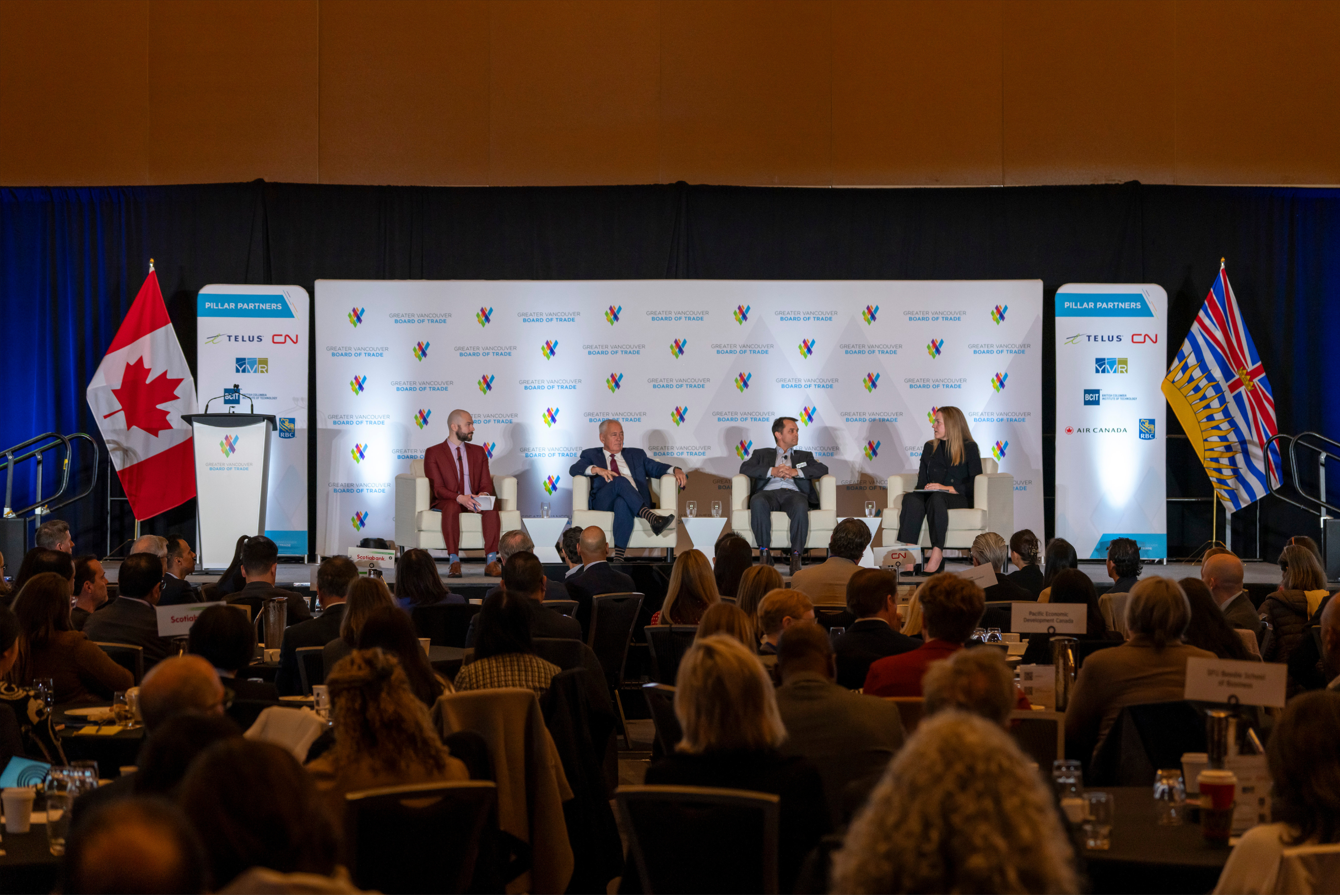
Our Economic Outlook Forum Presented by Scotiabank on January 29 and Energy and Natural Resources Forum Presented by Bennett Jones on February 19 brought business, industry, and government leaders together to discuss the current climate of doing business in the region and the areas of opportunity ahead.
Between the two forums, one strong message was clear – business, government, and workers need to unite to strengthen and grow our economy, making political leadership matter more now than it has in a generation.
While Canadian policymakers have reached the consensus that economic growth is necessary to improving conditions not only for businesses but all British Columbians, our forum speakers addressed how this rhetoric must be met with action.
We need to diversify trade, attract foreign investment, retain talent, and unshackle the economy to allow capital to flow. We need to be able to act faster and make it easier to do business in B.C.
“Changing policy and creating new programs to drive innovation is something we haven't seen in Canada for a long time, and I'm worried about the ability to do that by the current iteration of the bureaucracy,” said Glen Clark, Chair of BC Hydro, at our Economic Outlook Forum.
Policy plays a critical role in enabling investment and opportunity. Speakers highlighted how B.C. struggles to incentivize businesses to grow their roots in our province. Complex regulatory processes drive investment to competing markets while affordability and the cost-of-living drive away talent.
Speakers reiterated the importance of cutting red tape and getting regulatory processes in better shape so we can speed up major project timelines and build enabling infrastructure. Canada will only be able to meet federal economic benchmarks, like doubling exports to non-US markets in 10 years, by building these projects.
“The Minister of Energy exempted wind projects from the Environmental Assessment Office. It's a two-year improvement timeline to get things done. I think we need more of that,” Clark added.
Energy and Natural Resource Forum speakers raised similar sentiments. Our relationship with the U.S. has fundamentally changed. Diversifying trade is now a national imperative. The world wants B.C.’s resources, and B.C. has a geographical trade advantage. But being able to meet this moment starts with being able to build. Speakers expressed concern with permitting timelines, land use plans, and a lack of forward thinking to prepare B.C. for this level of necessary activity.
“What makes it hard to develop projects here is the timeline,” said Michael Davies, President & Chief Operating Officer of Trans Mountain.
“Our resource industry business cycle is probably about five years. It takes us two or three election cycles to get through getting a project from concept into construction. And so that can be improved by regulatory efficiency.” 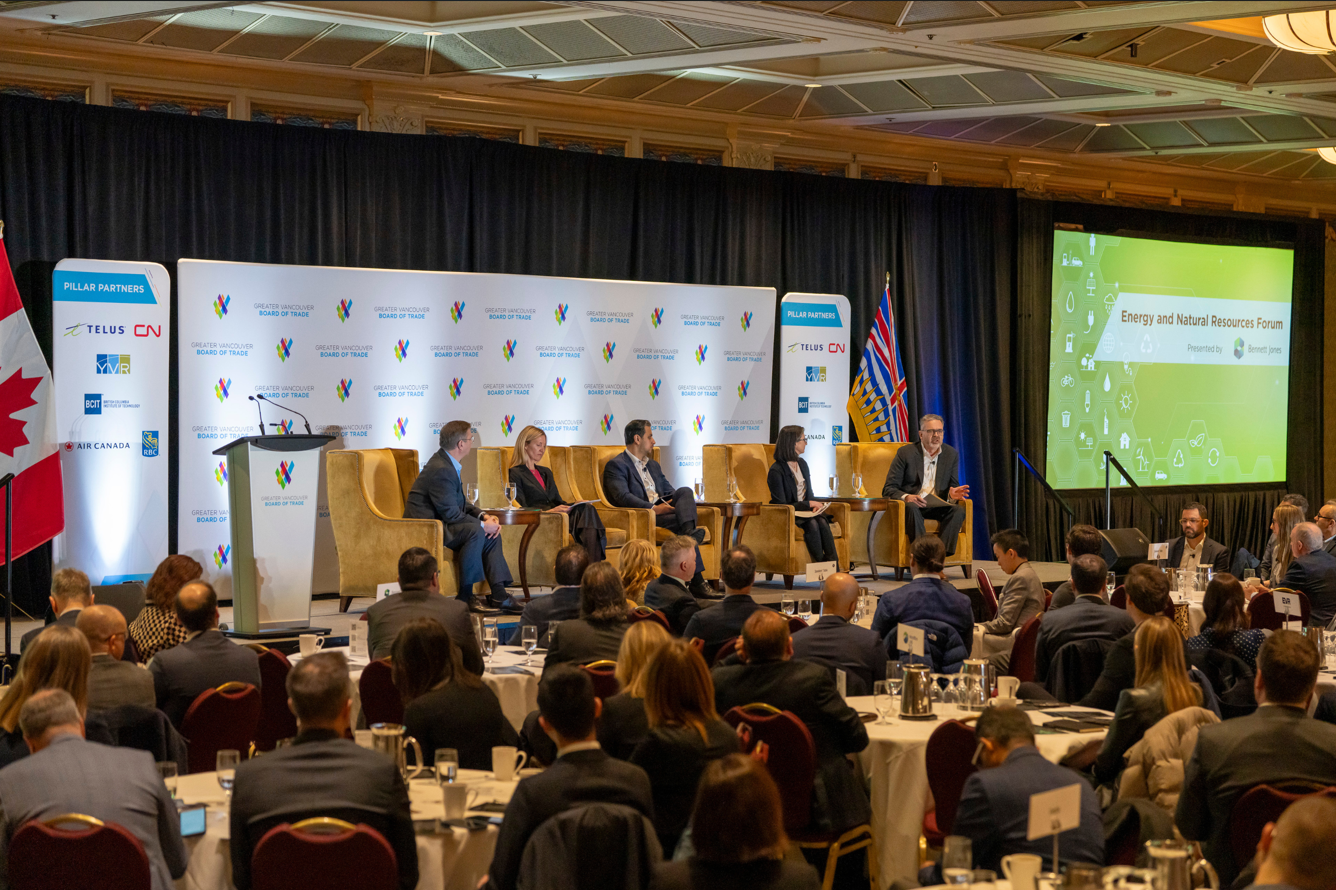
The federal government is aiming to ramp up natural gas exports via LNG by 2030. Dane Gregoris, Managing Director & Head of Oil and Gas Research at Enverus, said these targets would have been achieved already if all the projects proposed on the west coast of B.C. were completed within their sponsors’ expected timelines.
“I actually think the capital is not a problem in the world,” he said. “It’s really just the regulatory [challenges] and the will to get them done.”
Amid this momentum to build, speakers at both forums shared how we still need to continue to build with care. Environmental considerations and First Nations involvement should not be thrown out the window. In fact, this level of consultation gives B.C. a competitive advantage.
“We do things really well in British Columbia and in Canada when it comes to building things with care for the environment and in partnership with First Nations, and we can't lose sight of that,” said Alexa Young, Vice President of Government Relations and External Affairs for the Vancouver Fraser Port Authority, at the Economic Outlook Forum.
“The world is watching and looking for this. It’s what customers want. We need to say that out loud, and it will help in the long term. If we do that, we will retain the permission of the public and give permission to our politicians to make the right choices moving forward.”
These are challenging times, and the Greater Vancouver Board of Trade will engage government, convene industry, and apply sustained pressure to put leaders on the same page and move rhetoric into execution.
We will lead our continued advocacy, guided by our Agenda for Economic Growth, with the goal of accelerating decisions that unlock real-world outcomes, put shovels in the ground, dock ships in our ports, and generate dollars into our economy, forging a stronger path forward for all British Columbians.