Budget 2026: Tax hikes and red ink define difficult budget
For Immediate Release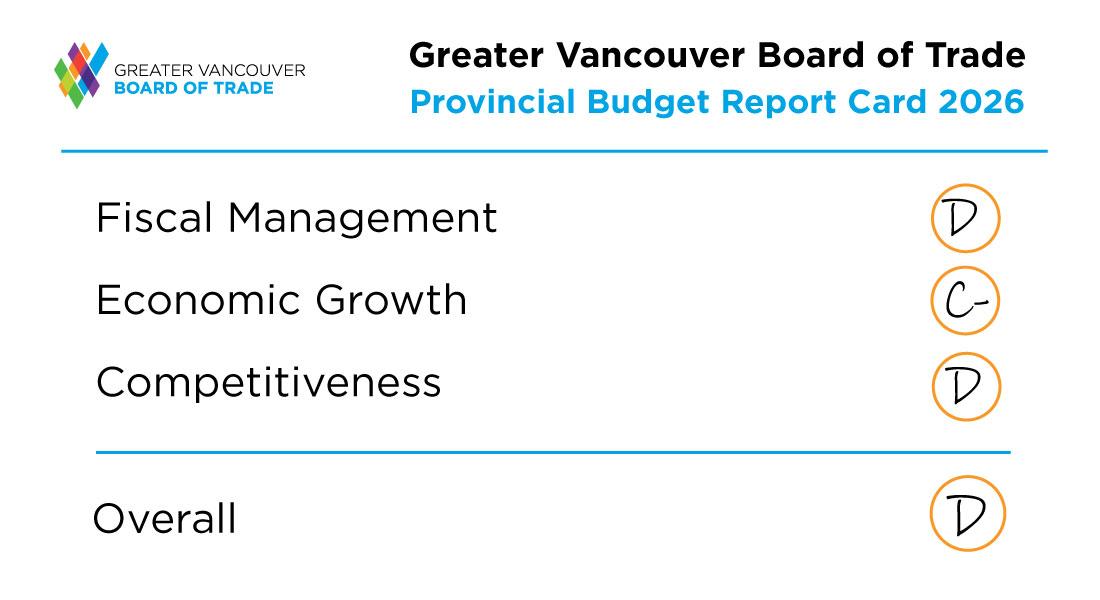
VICTORIA, B.C — On behalf of thousands of businesses across the Lower Mainland, the Greater Vancouver Board of Trade (GVBOT) has issued a letter grade of D for the 2026-27 provincial budget.
Senior GVBOT staff assessed the budget based on three core criteria: Fiscal Management, Economic Growth and Competitiveness.
The budget adds over $4 billion in new taxes, impacting all British Columbians, while also significantly increasing the debt and deficits. Importantly, the PST will now be added to the cost of professional services, including accountants, engineers, architects, property management, and others, which will hurt Greater Vancouver businesses.
"The budget confirms slow growth, higher taxes, and continued runaway spending," said Bridgitte Anderson, President and CEO of the Greater Vancouver Board of Trade. "Despite significant new tax increases, the provinces fiscal situation continues on a perilous trajectory, with an eye-popping $80 billion to be added to the debt over the next three years."
The government acknowledges that the public service has grown by an unsustainable 80,000 employees in just five years, though attempts to pare this back does not translate into a meaningful change in the fiscal situation. The cost to service the debt is planned to more than double to nearly $9.0 billion a year by 2028/29.
“We have been calling for incentives to increase local production and manufacturing, and so we were pleased to see the new Manufacturing Investment Tax Credit,” noted Anderson. “Initiatives to tackle permitting a new fund for to align with federal investments in defence and security and the new initiative to combat chronic property crime are welcome.”
Fiscal Management: "D"
Contrary to signals from the government, there was no forthcoming plan to stabilize provincial finances. The budget projects deficits totaling nearly $37 billion over three years. Total debt is due to rise to $235 billion by the end of fiscal plan, with our debt-to-GDP ratio due to more than double. The debt is growing 2.5 times faster than the economy, which is not sustainable.
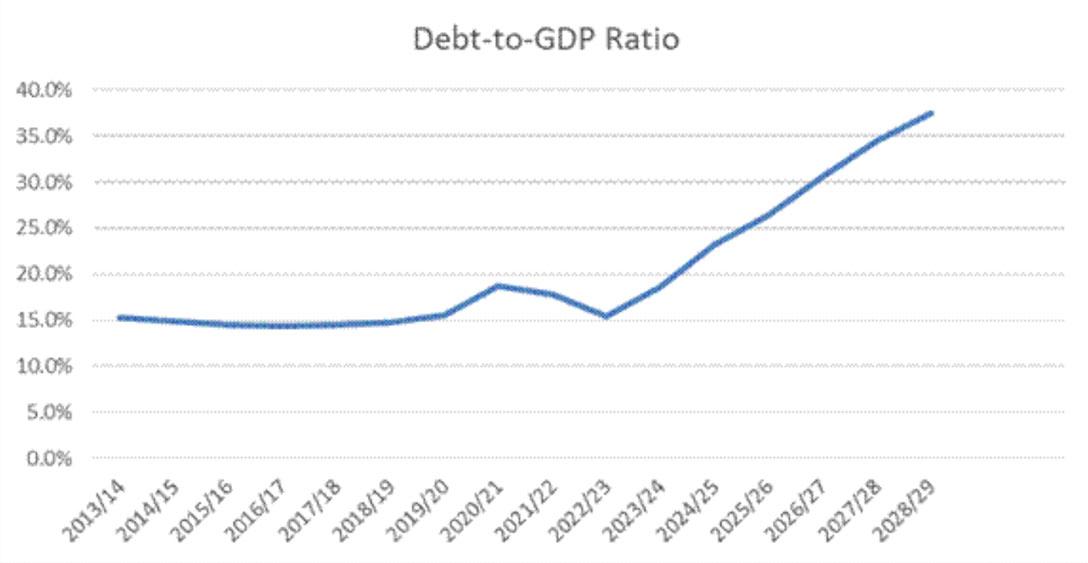
The interest bite (cents towards paying interest on debt per dollar of revenue), was 3.8 in 2024. Budget 2026 projects that the interest bite will more than double to 8.0 per cent by 2028, just five years later.
The budget increases the contingencies to $5.0 billion in each year of the fiscal plan. Priorities for contingency funding noted by the government include caseload pressures, compensation increases related to a new collective bargaining mandate, and emerging priorities.
Economic Growth: "C-"
The budget projects real GDP growth of 1.3% in 2026 increasing to 1.9% in 2027 and 2.1% over the medium to long term. This positions B.C. relatively well compared to the other provinces, but meaningfully slower than our pre-pandemic trajectory and far off 3.0%. Importantly, the pace of spending and debt accumulation is growing considerably faster than the economy.
While this year’s budget significantly increases taxes on all British Columbians and a large number of businesses, it provides some modest investments back from the billions of dollars of new taxes introduced in the budget.
Some new initiatives include:
- British Columbia Strategic Investments Special Account of $400 million to provide an opportunity to invest alongside the federal government in new economic initiatives.
- First Nations Equity Financing Program, announced in previous budgets.
- $40 million over three years is being committed to strengthen permitting capacity in natural resources and tourism sectors.
- Confirming the $241 million increase for skilled trades as part of Look West.
The most substantial economic initiative from the government continues to be a significant capital plan investing in transportation infrastructure, electrification, hospitals and schools. Part of the capital plan will be “rebalanced” to smooth out the capital spend.
Finally, Budget 2026 provides $16 million over the next two years to establish the Chronic Property Offending Intervention Initiative. The goal of this program is to reduce property crime, mirroring the efforts on repeat and violent offenders.
Competitiveness: "D"
The budget includes new tax increases that raise $4.3 billion in revenue for government over three years.
Accounting and bookkeeping services, architectural services, engineering and geosciences, selling non-residential services, security services and many others will now be subject to PST, adding an additional 7% to the cost and raising taxes by almost $1.5 billion. This will directly impact most members of the board of trade as they either provide these services or purchase them.
Additionally, most taxpayers in British Columbia will be paying higher taxes due to an increase in the lowest income tax rate from 5.06% to 5.6% as well as a freezing of the tax brackets, which usually change with inflation. These are substantive tax increases that when combined will raise nearly $2.5 billion over three years.
Real estate will face another slew of increases to the “School tax” for properties over $3 million in value, for non-resident buyers, and other measures.
Some positive tax measures in today’s budget include:
- A new, temporary Manufacturing Investment Tax Credit, to provide a 15 per cent refundable tax credit for qualified corporations investing in buildings and machinery and equipment used in manufacturing and processing.
- A commitment to consult and explore a Patent Box.
-30-
About the Greater Vancouver Board of Trade:
Since its inception in 1887, the Greater Vancouver Board of Trade has been recognized as Pacific Canada’s leading business association, engaging members to positively impact public policy at all levels of government and to succeed and prosper in the global economy. With a Membership whose employees comprise one third of B.C.’s workforce, we are the largest business association between Victoria and Toronto. We leverage this collective strength, facilitating networking opportunities, and providing professional development through unique programs. In addition, we operate one of the largest events businesses in the country, providing a platform for national and international business and thought leaders to further enlighten B.C.’s business leaders.
Media contact:
Federico Cerani
Communications Manager
Greater Vancouver Board of Trade
604-640-5450 | media@boardoftrade.com