More support for innovation: How recent SR&ED and clean energy tax changes could benefit your business
Canadian businesses have a timely opportunity to reassess how recent changes to federal tax incentives could affect their innovation and investment strategies.
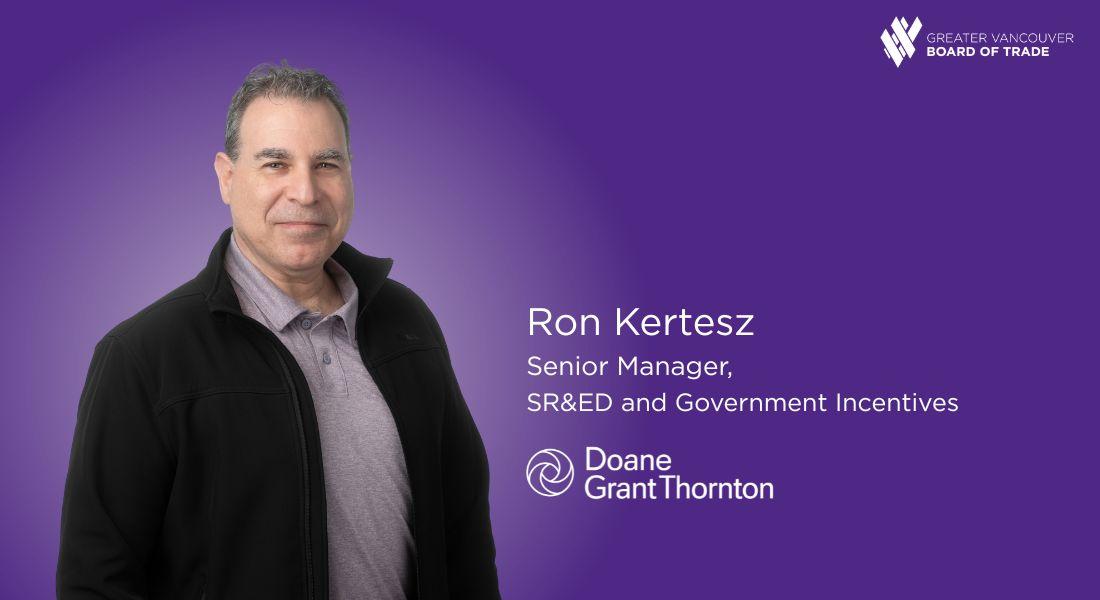
Written by:
Ron Kertesz
Senior Manager, SR&ED and Government Incentives
Doane Grant Thornton LLP
Ron.Kertesz@doane.gt.ca
Enhancements to the Scientific Research and Experimental Development (SR&ED) program and to Clean Economy Investment Tax Credits (ITCs), which were enacted in Bill C-15, are now law. These changes are designed to strengthen Canada’s competitiveness at a time of economic uncertainty, rising costs, and global pressure to innovate.
For many businesses, these changes may translate into improved cash flow, greater support for research and commercialization, and enhanced returns on clean‑energy investments — provided the opportunities are identified and managed carefully.
SR&ED IS NOW MORE ACCESSIBLE
Updates to the federal SR&ED program significantly expand access to refundable credits for both private and public Canadian companies. The amendments apply to tax years beginning on or after December 16, 2024, and include changes to:
- Raise the expenditure limit for CCPCs and their associated groups to qualify for 35% refundable tax credits to $6 million (from $3 million).
- Delay the phase-out of refundable tax credits by increasing the threshold range.
- Expand eligibility for qualifying Canadian public corporations and their consolidated groups.
- Introduce the phase-out for eligible Canadian public corporations and their consolidated groups with an average gross revenue between $15 million and $75 million over the preceding three fiscal years.
- Allow CCPCs to elect to have their expenditure limit phased-out by their gross revenues instead of their taxable capital.
- Reintroduce SR&ED tax credits for qualifying capital expenditures and lease costs — reversing a restriction in place since 2014.
EXAMPLE OF CHANGES IN PRACTICE
Let's say you’re a CCPC with $45 million of preceding year taxable capital in Canada, $40 million of average gross revenue over the preceding three fiscal years, $4.5 million of qualified R&D expenditures (not including capital expenditures), and preceding year taxable income of $500,000.
Under the previous rules, your expenditure limit is $375,000. As a result, your total federal tax credits would be $750,000 ($131,250 of refundable tax credits and $618,750 of non-refundable tax credits).
Under the new rules, your expenditure limit would be $3.5 million. This would increase your total federal tax credits to $1.375 million ($1.225M of refundable tax credits and $150,000 of non-refundable tax credits). In both cases, additional provincial tax credits may apply.
For many businesses, this incremental funding can materially affect reinvestment capacity, project timelines, or hiring decisions, particularly when combined with provincial incentives.
CLEAN ECONOMY ITCS AS A PLANNING LEVER
Businesses investing in clean energy and low‑carbon projects should also revisit their capital plans. The new Clean Electricity ITC is a 15% refundable tax credit that encourages qualifying entities to invest capital in eligible clean electricity property in Canada. The federal government also made changes to the Clean Technology ITC, Clean Technology Manufacturing ITC, and the Carbon Capture, Utilization and Storage ITC.
These incentives may be particularly relevant for utilities, manufacturers, energy producers, and infrastructure investors undertaking large‑scale capital projects over multi‑year timelines.
NAVIGATE THESE CHALLENGES WITH CONFIDENCE
While these measures create meaningful opportunities for businesses, they also introduce complexity. In some cases, the delays in passing this legislation may also allow eligible businesses to file amended tax returns for fiscal years beginning on or after December 16, 2024, potentially increasing SR&ED credits or ITCs already claimed. At the same time, amended filings and more generous incentives may heighten the risk of CRA audit, particularly for claims that were previously accepted as filed.
Engaging experienced SR&ED and tax professionals can help businesses identify eligible opportunities, evaluate whether amended filings are appropriate, and manage compliance and documentation — ensuring these incentives support growth while standing up to scrutiny.
If you need help navigating these changes or have any questions, Doane Grant Thornton LLP's advisors are here to help you. Learn more by visiting www.doanegrantthorton.ca.