Right the Ship: B.C.'s Capital Budget

British Columbia meaningfully increased what it spends on public infrastructure over the past decade, and the province does benefit from the hospitals, schools, highways and transit it has promised. But promises and delivery have come apart.
From 2018/19 to 2025/26, the province spent only about 75 cents of every dollar it budgeted for taxpayer-supported capital, leaving $19.8 billion of planned work undone. Meanwhile, the cost of approved projects kept climbing, often revealed in a single jump long after the original price was announced. The incoming government has promised an independent review of the province’s finances before it tables a budget. The capital plan should be a central part of that review.
Big Promises
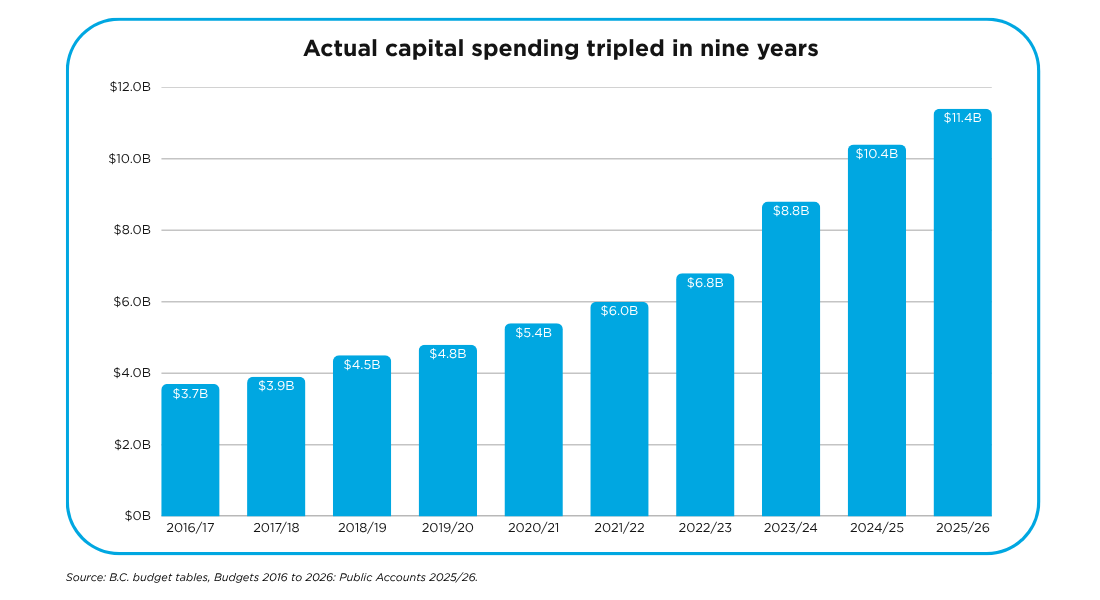
In 2016/17, the province spent $3.7 billion on taxpayer-supported capital. By 2025/26 that had grown substantially to $11.4 billion, more than three times as much, an average increase of about 13% a year. It also grew faster than the economy, rising from 1.5% of GDP in 2019/20 to 2.4% in 2024/25.
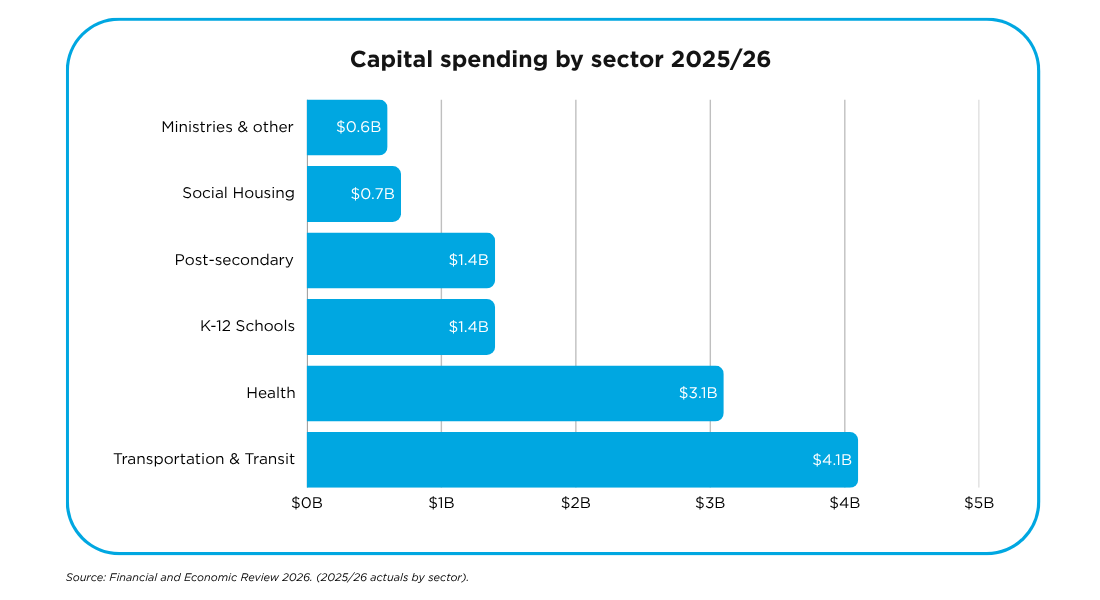
Transportation and transit investment increased almost fivefold, from $0.9 billion to $4.1 billion. Health capital increased to $3.1 billion and K-12 schools to $1.4 billion. Post-secondary capital spending grew more slowly, rising from $0.8 billion to $1.4 billion over the period examined in this study.
Big Misses
As the capital plan grew, the government’s ability to deliver on the plan was significantly diminished. In every year since 2016/17, the province spent less than it budgeted, and the gap widened as the plan grew, from $0.6 billion in 2016/17 to $4.0 billion in 2025/26. The province delivered nearly 90% of its capital budget in 2016/17. In more recent years, delivery has hovered between 71% and 76%. In other words, the province has been undershooting its planned annual capital spending by a quarter or more over the last few years.
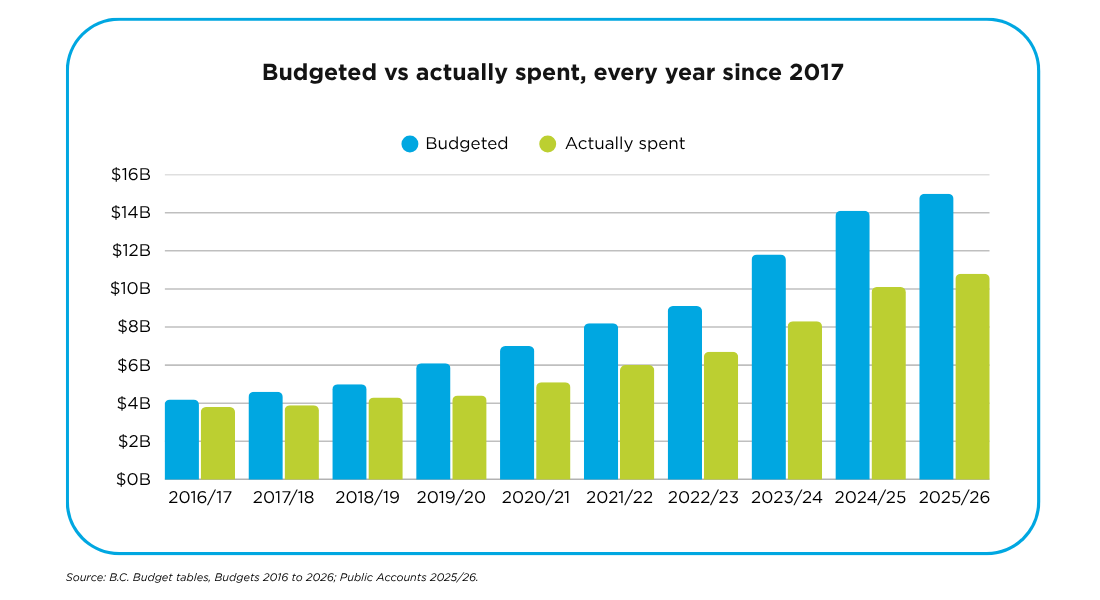
This past fiscal year is a perfect example of what has transpired. Budget 2025 promised $15.4 billion of taxpayer-supported capital for 2025/26. That estimate was scaled back at every quarterly update from the Ministry of Finance, to $14.7 billion, then $13.9 billion, then $12.5 billion. The province actually spent $11.4 billion, $4.0 billion less than originally planned. To put this into context, the government’s 2025/26 budget miss was larger than the entire capital spend in 2016/17. The Public Accounts simply say the spending "has been deferred to future years."
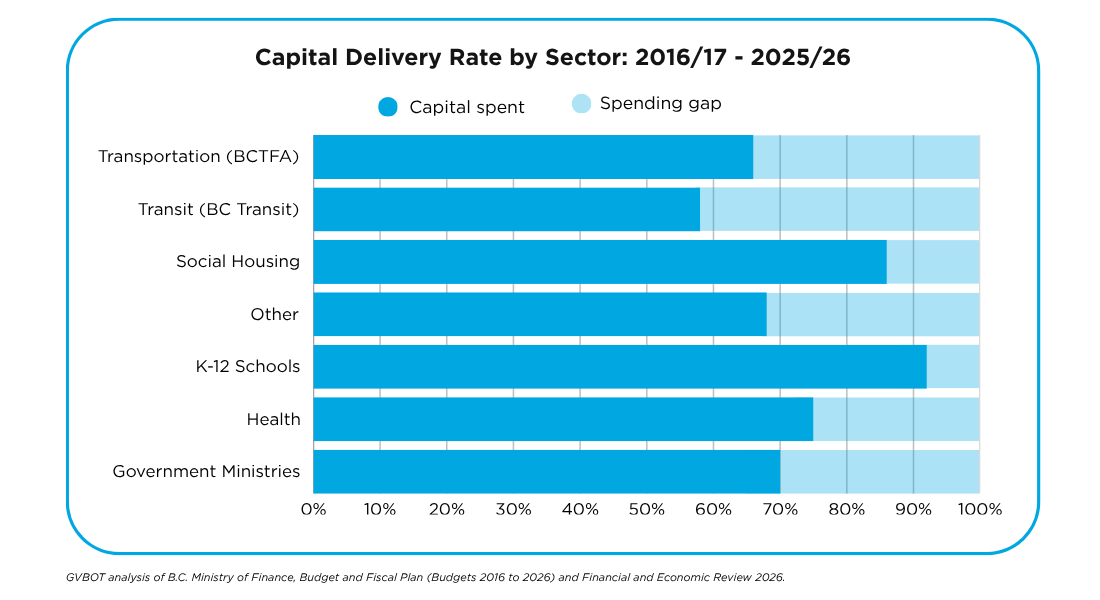
For some ministries, deliveries have appeared to worsen in recent years as capital commitments have expanded in size. For example, only 63% of the health-care capital budgeted for 2025/26 was spent. Of the major taxpayer-supported projects completed since 2016, only 54% finished in the year the government first promised. Today, 60 of the 152 committed projects are already behind their original completion date.
Cost Increases
While ministries have not delivered on their annual capital budgets, the cost of the projects they are building keeps expanding, and so do their timelines. The total value of approved major projects over $50 million rose from $26.8 billion in Budget 2016 to $91.7 billion in Budget 2026. Most of the increase stemmed from new projects, but $21.5 billion was due to cost increases on projects that were already approved, equal to one-third of the net growth.
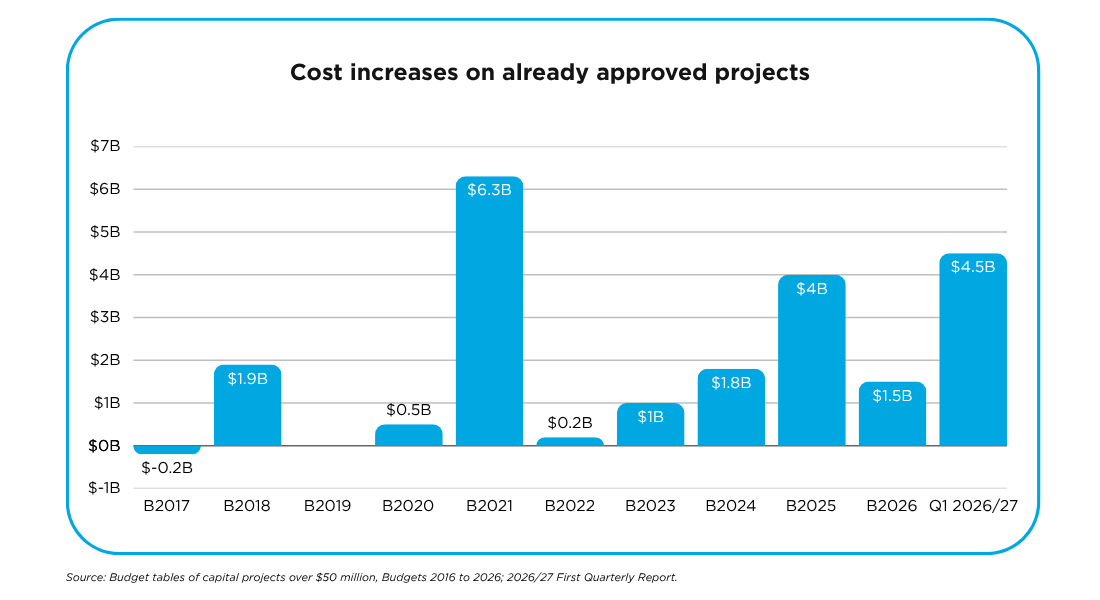
We have applied a rough estimate looking at the province's own history of cost growth. Using this estimate, we find there is likely to be another $7.1 billion in project cost increases not yet acknowledged, with a realistic range of $4.9 billion to $8.9 billion.
The Rising Price of a Kilometre
Board of Trade members are keen to see the expansion of Highway 1. This corridor is critical to the movement of people and goods through our region. So, we were pleased to see progress continue on the expansion of the highway over the past decade. However, the costs of Highway 1 widening through the Fraser Valley and other transportation projects show how rapidly costs have been rising and calls into question the oversight and management of these projects.
Initial phases of the highway expansion were completed in phases across similar flat land, and the cost has jumped from $15.5 million per kilometre in the phase finished in 2020 to $331 million per kilometre in the phase due to be completed by 2031.
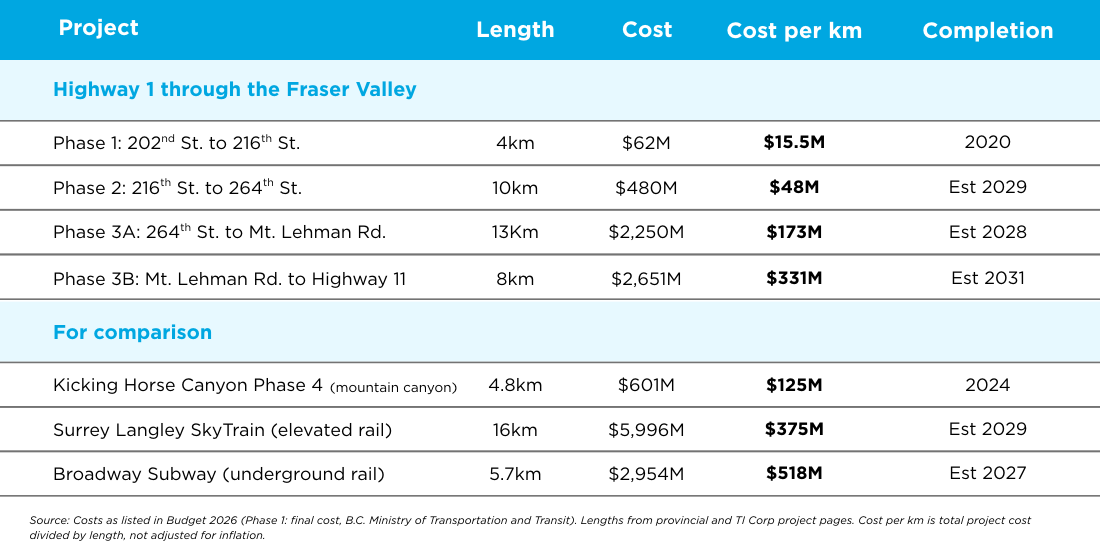
Construction prices jumped after the pandemic as materials and labour rose and supply chains tightened. As a result, a reasonable portion of the cost increases identified in the table can be attributed to inflation. Statistics Canada's construction price index for non-residential building in Metro Vancouver increased by 37% from early 2020 to early 2026. Industry participants and our members note that the index underestimates true cost increases.
Additionally, it is true that there are meaningful changes in project scope between the project phases that increase highway construction costs. Phase 1 was four kilometres of widening, with one new interchange built at 216th Street. The later phases are longer and rebuild more of the corridor, including new interchanges at Mt. Lehman Road and Highway 11. Phase 3B has some elements that seem to be much more complex than prior phases.
Phase 2 was first listed at $235 million in Budget 2020; it is now projected to cost $480 million and will finish five years late. Phase 3A was adjusted to be slightly below its original $2.34 billion budget.
However, the increase in prices between the phases is shocking. Even at today's prices, Phase 3A costs 8 times more than Phase 1 per kilometre. Kicking Horse Canyon, built through avalanche and rockfall terrain, cost $125 million per kilometre. A widening on flat land from Langley (264th) to Abbotsford is now budgeted at an inflation adjusted cost similar to that of Kicking Horse Canyon.
Delivery Models & Entities
Delivering complex public infrastructure is a challenging and multifaceted process that requires a highly competent public sector, strong management oversight, synergies, and close cooperation with the private sector. In B.C.’s recent history there have been many successful projects that were built on time, on budget, and fulfilled their purpose. Examples include the Canada Line and the Evergreen Skytrain Extension. The infrastructure landscape is not static, and so what delivered a project on time and on budget in 2006 will not necessarily work in 2026. Many contractors have stopped accepting fixed-price megaproject risks, B.C. has moved away from traditional P3s towards a “collaborative” or “alliance model,” and more risk has been assumed by the government with less competition. These trends – some reinforced by policy choices – have created conditions ripe for cost escalation and higher risks for B.C. taxpayers.
What changed
- Inflation: Non-residential building costs rose significantly during and in the early years following the pandemic.
- Fewer bidders: SNC-Lavalin, Fluor and Granite and others left fixed-price contracting in 2019 after megaproject losses.
- New models: Infrastructure BC's 2024 pipeline used design-build, progressive and alliance models instead of P3s. The Surrey Langley SkyTrain was split into three contracts, each with a different model.
- Labour: Since 2018, many provincial projects have been built under the Community Benefits Agreement, which government estimated would add 4% to 7% to costs. CFIB has estimated that these agreements increase labour costs by up to 30%. Because they reduce competition for bidding, higher costs are inevitable for projects covered by CBAs.
Given the significant cost escalation, it is important to ask whether the new project development and building models are delivering as intended and whether the government is set up to effectively deliver value for taxpayers. We recommend a full review of project procurement and management, including the efficacy of the government’s owner-management model for these projects. The review should consider, amongst other things, structural governance, whether the government has the right skills, and the project planning process.
Both the government and private sector have estimated that there have been cost increases associated with Community Benefits Agreements – and, specifically, the use of B.C. Infrastructure Benefits Corporation. It is our view that this model has driven up costs, reduced competition, created inefficiencies in delivery, and sparked confusion in the market.
Who Pays
Board of Trade members build projects, working as contractors, architects, engineers, and more. Our members also benefit from projects, such as new transit and transportation infrastructure. Like all British Columbians, GVBOT members want to see improved economic and social infrastructure that benefits our province.
At the same time, these projects and their costs need to be sustainable. If projects are not properly managed and costs skyrocket, ultimately, it will mean that we pay more and/or get less. A growing capital plan that is not effectively managed would be a cause for concern on its own. However, this is coupled with a growing and unsustainable provincial government operating deficit and a soaring debt, placing British Columbia’s finances on an unsustainable path.
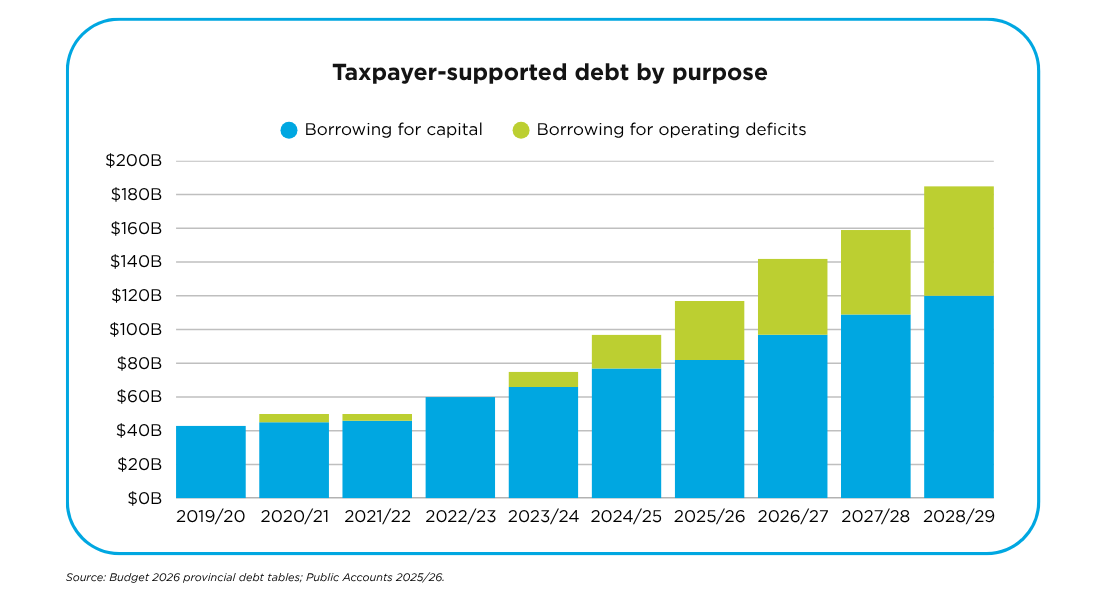
Capital spending in B.C. is separated into two buckets. The first is taxpayer-supported capital. This is spending on hospitals, schools, highways, transit, social housing, and other public assets by provincial ministries and by public bodies the province funds. It is financed mainly through provincial borrowing and revenue, with some costs shared by the federal government and other partners. It is the primary focus of this paper. Self-supported capital is built by commercial Crown corporations, mainly BC Hydro, which pay for it from their own revenue, such as electricity rates. It adds to total provincial debt, but not to taxpayer-supported debt.
Operating debt is money the provincial government has borrowed to cover day-to-day costs when spending on programs and services is more than revenue. In 2019/20, the province had no operating debt at all. By 2028/29, operating debt is planned to reach $69.0 billion.
B.C.’s taxpayer-supported debt rose from $46.2 billion in 2019/20 to $117.4 billion in 2025/26, and Budget 2026 projects a further rise to $189.0 billion by 2028/29. Roughly half of this increase is operating debt (48%), while the other half is attributed to capital.
Both add to the cost for taxpayers through higher interest payments. Interest payments on the debt are on track to take 8.2 cents of every revenue dollar by 2028/29, double the 2024/25 level. Budget 2026 projected this would lead to an additional $4 billion of taxpayer-supported interest costs per year over the same time period. A crude metric would attribute $2 billion of additional annual interest costs to taxpayer-supported capital. To put this in perspective the additional $2 billion is the size of the PharmaCare program.
Market interest rates have risen above what Budget 2026 assumed, and B.C. now borrows with lower credit ratings than when the budget was tabled. The incoming government has promised to closely examine B.C.’s deteriorating fiscal situation. We believe this is sorely needed as the province is on what can be described as a clearly unsustainable fiscal trajectory.
Overall, the province’s capital budget has increased significantly in recent years. At the same time, project budgets have ballooned, deadlines have been missed, there is less transparency, and value for investment is increasingly unclear.
Recommendations
British Columbia’s capital budget has increased dramatically in recent years, in part due to inflation and the demands placed on infrastructure from population growth. Our members want to build these projects and see British Columbians benefit. However, today’s cost overruns mean fewer projects in future years. At the current pace, B.C. is on track for historic increases in public sector debt that will substantially restrict our ability to build new projects or fund government services in the future. To start to right the ship, the incoming government needs to develop a multi-year capital plan the province can deliver, price honestly, and afford. We call on the new government to make the capital plan a part of its review of the province’s finances, and to act on these four recommendations.
Recommendations
-
Review how B.C. delivers major projects. As part of its independent financial review, the government should examine its delivery models, its capacity as a project owner, its governance, and its project planning. It should report publicly within a year on what is working and what is not.
-
Report delivery transparently. Increase transparency of the capital plan by project and sector.
-
Restore competition and reduce avoidable costs. End mandatory Community Benefits Agreements and the B.C. Infrastructure Benefits model for project delivery. Review all regulatory requirements affecting projects with a view to streamlining costs, timelines, and approvals.
-
Right-size the plan. Prioritize projects transparently, ensure appropriate skills and delivery capacity are in place, and right-size the capital budget to what we can afford.