Trading with Canada: Chapter 1 - Capitalizing on British Columbia’s $134B Opportunity
Canada has always been a trading nation. For decades, expanding exports has largely meant looking beyond our country's borders, and thus we have geared our regulatory framework and infrastructure to get our goods and services to global markets – in particular the United States.
However, as our relationship with the United States regretfully continues to fray, there has been a renewed interest in a market we’ve inexplicably left alone for too long: Canada itself.
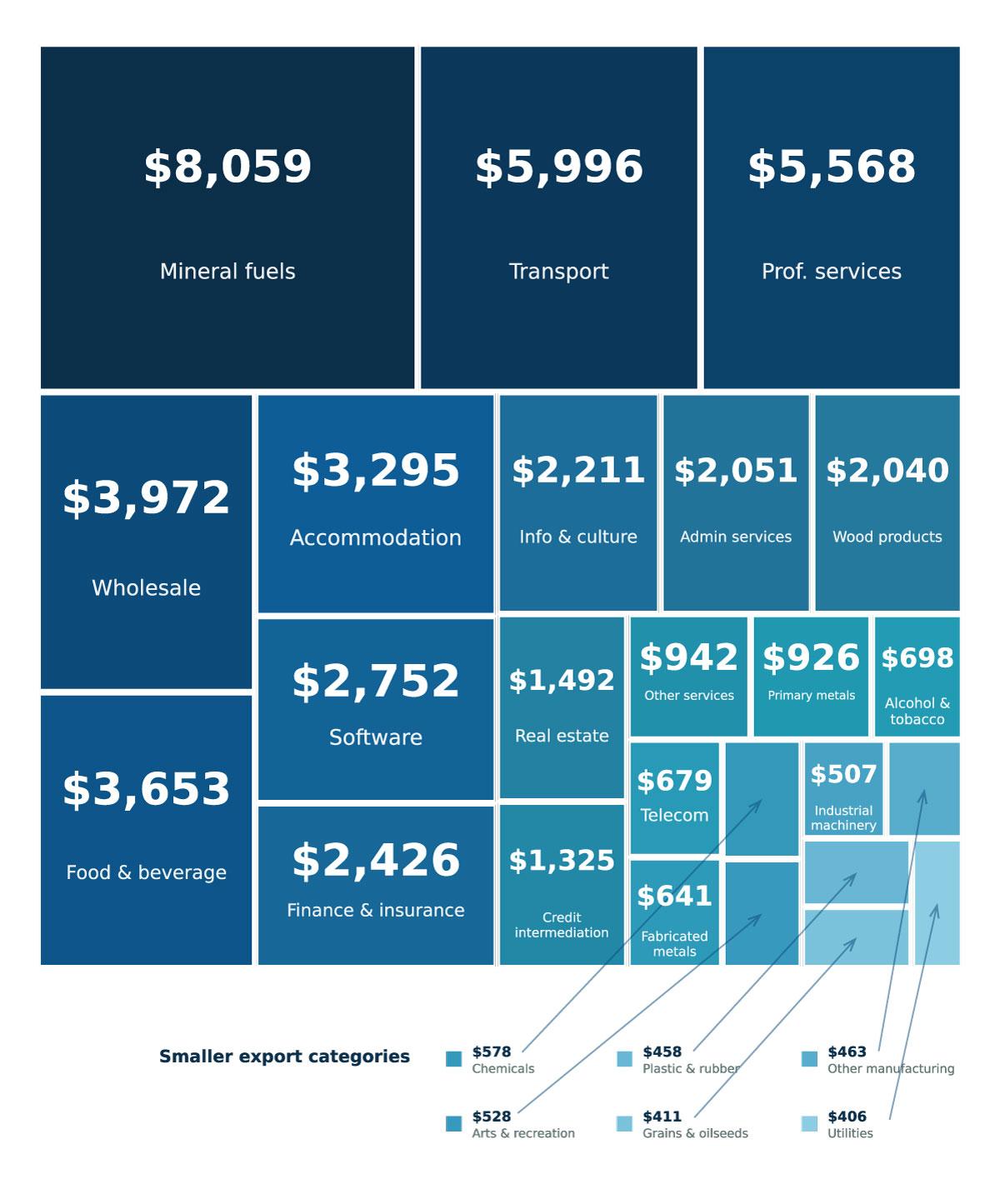
In 2022, British Columbia traded approximately $134 billion in goods and services with the rest of Canada. Of that total, B.C. exported more than $56 billion to other provinces and territories, making the domestic market one of the largest and most important opportunities available to businesses across the province. Nearly two-thirds of those exports were services, highlighting the growing importance of knowledge-based industries in B.C.'s economy.
All of B.C.'s interprovincial exports by product, visualized by value ($M, 2022)
For many years the Greater Vancouver Board of Trade and other business groups have called for a loosening of Canada’s interprovincial trade barriers. The International Monetary Fund (IMF) estimates that non-geographic, policy-related interprovincial trade barriers in Canada impose costs equivalent to a national tariff of about 9 to 9.5 percent. Fully removing these internal barriers could boost real GDP by nearly 7 percent (roughly $210 billion) over the long term.
While we had real momentum in the early 2000s with the New West Partnership Trade Agreement, much work remains to be done.
In Fall 2025 we saw all provinces sign the Canadian Mutual Recognition Agreement which aims to break down interprovincial trade barriers, making it more accessible for businesses to sell products across the country, and for people to purchase Canadian goods. In Summer 2026 Canada’s premiers announced that several provinces will introduce direct-to-consumer (DTC) alcohol sales, a significant step toward reducing interprovincial trade barriers and strengthening Canada’s domestic economy.
There is still a lot of work that remains to turn these agreements into actionable policy and regulatory changes that create a true free trade system amongst our provinces and territories. Yet removing barriers is only part of the story. The bigger question for B.C. business leaders and entrepreneurs is where opportunities actually exist.
Which provinces offer the strongest growth potential? Which sectors are best positioned to expand? And where does British Columbia hold a competitive advantage compared with businesses elsewhere in Canada?
These are exactly the questions that inspired the Greater Vancouver Board of Trade, in partnership with PacifiCan, to launch Canada Connects, a market expansion accelerator designed to help B.C.-based small and medium-sized businesses grow across Canada. The program helps businesses expand into new Canadian markets through practical training, market intelligence, expert guidance, buyer connections, and interprovincial trade opportunities.
To ensure Canada Connects is focused on the markets and industries with the greatest potential for success, the Greater Vancouver Board of Trade conducted an in-depth analysis of trade flows, market demand, and sector competitiveness across Canada's domestic economy. The goal was simple: identify where B.C. businesses are most likely to find new customers, build strategic partnerships, strengthen supply chains, and generate long-term growth.Several clear themes emerged from the findings.
First, the strongest opportunities for B.C. businesses are not spread evenly across the country. While every province represents a potential market, the analysis shows that a relatively small number of jurisdictions account for the vast majority of current trade activity and future growth potential.
Second, British Columbia's competitive strengths are diverse. Natural resources remain critical, but many of the province's strongest growth opportunities are increasingly found in professional services, software, research and development, information industries, transportation, and other knowledge-intensive sectors. 62% of all British Columbia’s exports are services.
Third, some of the most promising opportunities are emerging not from entirely new industries, but from expanding existing B.C. strengths into markets where demand continues to grow.
The findings from this analysis will help shape the market intelligence and business development support delivered through Canada Connects. They identify the provinces, sectors, and trade corridors where B.C. businesses are best positioned to expand, providing a data-driven foundation for helping participants connect with new customers, distributors, procurement opportunities, and strategic partners across Canada.
Over the coming weeks we will continue sharing insights from this research, including:
- The provinces that offer the greatest opportunity for expansion.
- The sectors where B.C. businesses are most competitive.
- The fastest-growing trade corridors within Canada.
- The emerging opportunities that could shape the next decade of domestic growth.
The conclusion is straightforward: one of British Columbia's largest growth opportunities may not require crossing an ocean or entering a new international market. It may involve strengthening our presence within Canada's own economy.
As more businesses look to diversify and reduce their exposure to international volatility, Canada Connects is designed to help them seize that opportunity, translating market intelligence into practical action and connecting B.C. businesses with growth opportunities across the country.
In our next article, we'll examine which provinces offer the largest growth opportunities for B.C. businesses.